
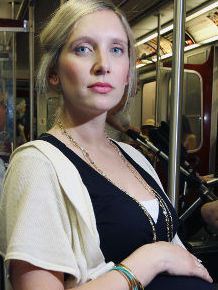
The girl is wearing a leather jacket, expensive-looking shoes and has red hair; it’s smooth and shiny like an ad for shampoo. It covers her face, as she bends over her phone.
A young boy, quarrelsome and hooded abruptly exited at the stop. He shouted, “Whatever “and threw himself through the gap of the closing door. Now it’s just me and her in the carriage. I can’t help looking at her from time to time. Every time I turn to her, she turns and gives me an irritated look. I would like to say, I’ll be quiet, I won’t bother you and I won’t make a pass, but that would mean bothering her and making a pass.
So I do my best to look elsewhere.
Not much for the eyes. Advertising I’ve seen before but every few seconds my glance returns to them like to a nagging concern, with a sense of malaise. There’s a woman with violet eyes, in front of a violet sea, saying We Bring You Far Away.
The red chair handles carry the greasy passage of an ocean of individuals. The geometries in the design on the chairs are in dark colors, intended to distract the eye and keep it unaware of lingering stains and dirt. The black tunnel and hissing of the subterranean night flow outside the window. Where again I see the girl reflected. She looks up again, impatiently. There is nobody else here but you, you’re even pretty, what can I do? My eyes come back to you even if I don’t want them to.
I close my eyes. It feels good. I feel the tensions of the day tingling between my shoulders and neck, dressing me like a cloak. That is natural. I am thirty-seven years old; it’s time for me to rest.
I’m tired. Last night I didn’t sleep. Got into London yesterday early in the morning. Then I had meetings, one after the other, dragging my leaden suitcase through the city. And then, in the evening I went to Alessandro’s place. It was a mistake not to go to a hotel.
He still laughs like a child, but became a doctor, Alessandro the Epidemiologist. He has a good job in a prestigious hospital. His hair is gone, but the rest is the same. Almost, he and his wife separated just last week. She ran away with a DJ on Wednesday, without any hint or foreshadowing of the coming crisis. So we talked a lot, drank too much and slept little. And after he swallowed all his wine and cried all his tears, Alessandro dragged himself to bed. I never got to sleep. His troubles continued to buzz like an electric aura around my head.
I start to doze, it’s a good feeling. My thoughts are gradually transformed into images. Soon I’m dreaming: I’m in a hospital room, and the light is dim. Alessandro stands the corner and watches the screen of a machine. There’s a bed, in it lays a thin old man, and a girl sits next to him and strokes his forehead. He holds a small chest, a wooden box that looks antique, it’s reinforced with nails. He opens it with a small key, and a twinkle spreads in the dark room; it’s full of gold. Leaning to on the side of the bed, he holds the chest open in front of her, sliding the coins between his fingers.
“Here, my daughter, your heritage, your dowry.”
Then the man leans back on the pillow and dies. The girl remains with bowed head, her hand in her father’s.
The contact of the metal on my forehead wakes me. I turn away from the grease and germs of the handrail. I would like to have one of those disinfectant wipes; I am not accustomed to the promiscuity of the metropolis. Foolishly, I think of Ebola, the little evil traveler that marks the map of human displacement, scaring everyone with its potential, the opportunity to settle in and demolish our carcasses in a jiffy.
Our body wears two kilograms of germs. Alessandro told me. Later I looked it up on the Internet in an attempt to soothe myself and all my sleepless sheep, counted and recounted. His wife – his ex, now – is obsessed by bacteria. She washes and sanitizes her hands at least forty times a day, first with soap, then antibacterial gel. Maybe that is why she was with an epidemiologist.
Alessandro said that bacteria live in our bodies, but are not part of it; they just ‘are’. They have a life of their own. They’re born and die, they come and go. Yet, without them we could not live. They’ve created an iron alliance with our cells, and now we cannot survive without each other. My doctor friend said, we are colonies, rather than individuals, his head in his hands, tears running down his cheeks for reasons independent of the nature of bacteria.
The internet confirmed it. We are an infested territory, invaded by a swarm of creatures who do not even know we exist, soaked in our blood, clinging to the tissues of our organs like a rock wall. A living mass that is enriched every time we taste a grape, touch a handrail, or lean our head against the cold vibrating glass of a metro car. We are their world, their means of transport that they use to cross the universe for free.
I shake off my sleep when someone touches my shoulder.
It’s the red haired girl; she stands up and stares at me from above, her head tilted like a curious dog.
“Are you asleep?” She asks in Italian. Yeah, must not be too difficult to guess my nationality. I just look at her astonished and nod my head.
She looks worried. She squint her eyes and she teased the edge of her teeth with her nervous and mobile lips.
“Can I ask you something?”
“Sure, whatever you want,” I say. I guess it’s to talk about some problem with the hooded boy.
She bends down a little, and narrows her eyes, like when you look at a dress with a speck on it or a motor that does not make a nice noise.
“I dreamed of you.”
“Me?”
She nods silently.
I examine her. She seems worried, even embarrassed, but normal, not unbalanced, crazy, or under the influence of drugs.
“I dreamed about you last night. You were dressed differently, not like now, but it was you. I was walking along a path and when I turned there you were, waiting, standing in front of the trunk of a tree. You said there was something you had to tell me, and then you leaned your head back and fell asleep. The same thing you did a minute ago. You rested your head, closed your eyes, with your mouth slightly open. Exactly like the dream, I don’t think I would have recognized you otherwise.”
I can’t help but smile, feeling a little embarrassed.
She touches my arm, she had rough, manly hands, I almost jumped at the contact.
“Tell me. Tell me.”
“What?”
“That thing, the thing you have to tell me.”
Now I’m fully awake.
I try to put together my poor faculties. She wants me to say something. The thing I have to say. She needs help. A crisis with that hooded boy must be a serious story. She wants to be comforted, wants to have a chat, that’s all. Let’s try, let’s talk. I’m good at calming people.
“This is a difficult time in your life,” I begin, and already I feel like a palm reader.
“Yes.”
If only she would talk, give me a little data to build on. Instead, she stays silent and waits for the message that I have promised her in a dream.
“You’re facing an important choice.”
“Yes.”
I lower my head, I get frustrated. I feel ridiculous. Soon I’ll say: a tall dark stranger will bring you an unexpected gift.
“That boy haunts you.” I say.
“Do not talk about him.” she interrupts, “Tell me what you have to say and that’s it.”
Perhaps she has noticed I don’t have anything to say. No, she’s not disappointed, she’s waiting. She looks at me like I’m her last hope. Come on, I have to pull out something. Unreasonably, I start telling her about the dream I just had as if it were about her. I can’t think of anything else.
“Recently, you had a gift … or rather, a legacy.”
Her eyes light up.”That’s right.” Then it was something else, not the fight with her boyfriend.
I want to know, to get information, to question seriously. Instead I’m the one who has to speak. I have to continue.
“The man who gave it to you … Well, he is gone.”
She nods, seriously. She seems to know what I’m talking about? I invite her to sit down. I take my time, and now what?
She sits. Touches me again, her fingers on the skin of my hand, so another few thousand bacteria get a free ride, migrating through our fingers. Now we have something in common, we are contaminated with each other.
“Quick.” she said “I have to get off soon. Now, or I’ll miss my stop. ”
I continue. “It’s a good thing for you. It is your treasure, your dowry. And although he is gone forever, you are left with a precious thing. ”
She looks at me with eyes so intense that I don’t know what to say.
“That will be with you for the rest of your life.”
She gets up, it is her stop. Her expression suddenly changes, she is serene. It seems that I said what I had to say.
“What’s your name?” She asks from the door.
“Matteo. You? ”
“Bea”.
“He is gone forever. Left me this, just like you said,” she says softly. And as she slips out she caresses her belly that, now I notice is quite prominent.
I get up and I lean towards her side. She is still there, standing and smiling.
“Wait! You mean …? “I point to her belly. How strange, I was not able to see her as a means of transport.
“If it’s a boy I’ll name him after you.”
The train leaves the station behind: travelling fast inside a tunnel, under a city, on the surface of a planet. Our planet, mother Gaia also a gigantic creature that lives and breathes, and carries us like germs. Driven by the Sun in a spiraling gallop along with her cheerful litter of planets, in some peripheral corner of a universe that science says is moving faster than any train.
The universe carries us all. Everything transports and is transported.
The ancient sages of religion say that life itself is a means of transport. Carrying us to someplace distant and desirable, from a bank where brutes like us, will arrive as angelic creatures.
Today I learned how words travel, from mind to mind, and from dream to dream.
I get up. The next stop is mine. I’m not sorry that I didn’t leave with Bea, true I might have known her better, talked more perhaps, who knows, spent the night with her. But a meeting is a meeting, and lasts as long as it lasts.
We exchanged consolation and bacteria. This is what had to happen.
I did not realize one could dream for another. Now I know that we are also the means of transport for words, written and spoken and even unspoken. We carry them around with us, and deliver them to those who need to hear them.
 Ideas for a tall story