
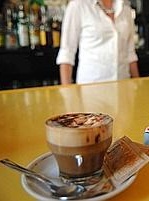
I’m a barista. I have a cafe in the center, the best. Even Neapolitans say that my espresso is incomparable. For four years I have been serving you an espresso lungo every morning. You do not want anything else.
You always enter early: an elegant man, ready for work, always cheerful, invariably asking me how I am. I reply with a shrug. You do not need to order. You always want the usual. We know each other well. We often meet, go on walks and have dinners in the same circle of friends. This includes your wife, who likes me. A special person, she says. I think she suffered a lot. No one would suspect that it is because of you that I suffer. I have always loved you without hope, since the first moment, without anyone noticing anything. If you were asked if I liked you, your answer would be, who, me? I don’t think so.
You have just gone out. I put your cup in the dishwasher with invisible tenderness and stop to look at the people seated at the five tables. I am sure to attract a certain type of clientele. The unhappy. Fixed stares on faces accustomed to boredom, expert in driving out the sorrow, in getting distracted, in forgetting and not thinking about it. You recognize them: people are marked by suffering in a way that is impossible not to notice. More delicate, tenderized like steaks well worked with a meat pounder. Radiating pain, invisible and as easily recognizable as a trail of perfume. Drugged with gossip, news, alcohol, shopping and travel. Distractions with which they started to feed a creature, a simulacrum of self, a sociable puppet who they have learned to send ahead into the world to meet others, while they are huddling, trying to forget, to sleep. I know what each of my customers is thinking, when for a moment they stop this unnecessary exercise of distraction and suddenly remember. They think: no one suffers like me.
But they are all wrong. No one suffers like me.
I’m an expert. I have accumulated thousands of hours of suffering, like an airline pilot logging flight hours. This number of hours is what qualifies me.
I utilized my suffering. I gave up any attempts to forget. I held it before my eyes without sparing. I learned how to use it. I made bricks with which I built a lonely and invincible fortress. The pain of love is such, it doesn’t lend itself to be forgotten, since the object of pain and that of love, to which you constantly return, are one and the same.
A few weeks ago I recognized, on the street, someone like me. A lovesick soul. Neither deluded that she could have it, nor able to let it go. Sunken eyes, something in the corners of the mouth that can not rest. I know what it is. It is non- acceptance, paired with unwillingness to believe. Desire without hope. Our eyes met for a moment and then we quickly turned, simultaneously, and walked away in opposite directions.
I am very good at hiding. I never said anything that would generate the least suspicion, I never gave myself away. To express is to squeeze, to extract something that is less than what it originally was. I know that since I make juices, and I feel like the hollow remains of lemons or grapefruits that I throw into the bin.
Expressed love is ridiculous, unexpressed love is noble and has a strength equal to that of death. Everything bows before it.
As a young girl someone who was my boyfriend told me I was still a child. He was right, I felt: he would give off a mature energy, unthinkable in a male of that age. I asked him what makes you grow up. He replied that you don’t grow up until you have a bereavement. His sister and his mother had died in an accident.
I found myself hoping for some impossible form of painless mourning to free me. A mourning without death.
Now I am definitely fulfilled. The problem with wishes is that they always come true.
Eventually, I too had real loss. But this, I am ashamed to say, is stronger. I wish you were dead; instead you reappear every morning between eight thirty and twenty to nine, with your unsuspecting face. You have not suffered. You’re still a child, you’re Adam before the apple. And that is why you see so little, why I love you so much.
I started reading the Buddha. He says that when you don’t desire anything you arrive at a kind of happiness that is better than happiness. He calls this detachment. He, too, must have suffered a lot, in order to develop such an idea.
I started smoking again. I am constantly sick, I am exposed to all the viruses and the colds that are out there. I eat two cloves of raw garlic every morning. My breath must reek. Yet, the men around me fall in love with me. They follow me on the street, making propositions within seconds of meeting me. As if they knew me, as if I encouraged them. As if pain were a kind of pheromone. All except one, of course, you. You’ve never seen me.
I talked with my analyst. Yes, for a while I had an analyst. There was a time that I decided I had to get over it, and I tried psychological therapy. I remembered a phone number that somebody had given me a couple of years before. Why is it, doctor, the emptier I am the more men I have around me?
He hugged me. A non-therapeutic, non-fraternal hug. He told me that perhaps the best thing for me would be to disconnect, to get away from everything and everyone. He has a house in the hills, we could go to live in it. We could stay there for a while: six months, one year, relax, let it go, make love, if I wanted to.
But isn’t it against the rules, I asked. What rules, he said. Professional ethics, I replied. He took a look at his notebook, as if we weren’t talking, and he changed the subject, introduced a new idea. You know, maybe you’re the one who needs help, I said; he raised his eyebrow from a far away and inaccessible place. I never went back.
I returned to soaking in silence, waiting every day for half past eight in the morning, the moment to serve you espresso with a tiny chocolate and a small glass of water, in the cup that I chose for you, that I have been warming on the coffee machine since early morning, that I have been touching and caressing with my eyes until the moment you step in and greet me lightheartedly, unable to read my rimmed eyes, not suspecting that you are the candle around which every night I circle in ever diminishing spirals until I burn.
“How are you?” You asked me just five minutes ago. I stared at your lips, touched by the paper towel that you threw, as usual, inside the cup, with an infallible and smug shot.
I smiled and shrugged. “Here, your espresso”, I said.
Words are nothing. Actions and explanations are nothing. Plots of stories are nothing. The hot and dense espresso that I have put in front of you and has awakened your senses with its pungent and bitter aroma, is nothing. Real is only that which is made to remain unexpressed. Unespressoed.
 Ideas for a tall story