
Divided into Two Parts.
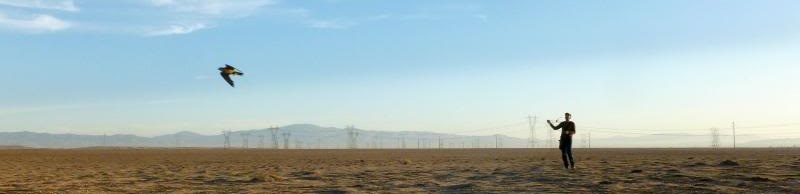
One, the falconer, well planted on the moist soil with legs slightly apart, with tight, confident lips and, perhaps, a cigarette dangling from them. His eyes are half-closed, turned towards the sun and his face weathered by the seasons spent outdoors, and his left arm is still raised, although weighed down slightly by a satchel and an old, worn, brown leather glove. His gaze keeps returning to the distant, moving speck above him which he believes he controls, relying on practiced reactions, learned techniques of discipline.
The other, the hawk, released from its black hood, is gliding so high that it seems motionless, describing a wide circle which includes an extension of immense valleys and hills, cut by a river that slowly advances its water and sparkles and glints in the sun like a twisted knife. Ruffled by gusts of wind, it remains on course with tiny adjustments of its wing muscles; relaxed, ready, absorbed, open, attentive to whatever moves and, for a moment, it turns its back on the man below it and forgets him.
Then the man turns to look at the bird changing direction, darting after a shadow perhaps. At other times it is the hawk that sees, beyond the trees, the shape of the man, from behind, tying a shoelace.
Finally, for a moment, they look at each other. Isn’t there then a third element, the gazing, which is not the gazing of one or the other, but that which envelops them both as the light in which they are immersed, the indistinct whiteness in which they are formed, which was there long before them and will be there long after they have both dissolved and been absorbed into the surface of the Earth?
 Ideas for a tall story