
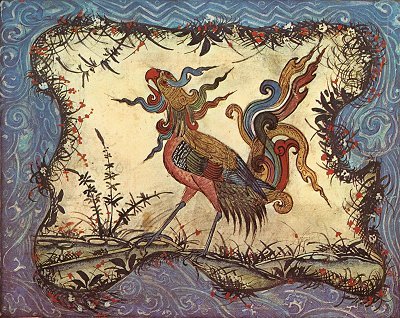
In a cloudless sunset, the full moon is already visible in the East. Four men, pilgrims to Mecca, rest in the shade of an oasis. Three old and a beardless youth. Barefoot, their heads covered.
After drinking tea in narrow glasses for a while and enjoying the silence of the proximity of the small body of water, one of them, a short, stocky man with a red beard and the definite eyes of a soldier, begins to speak.
“Dear fellow pilgrims, I am happy to have crossed your path. Although we do not know each other, it fills me with joy to know that we’re headed to the same goal.
We met with no intention, on the way to this oasis. But every time some event in my life seemed to be due to chance, I later saw the unmistakable signs of the divine will. Now I do not doubt that almost every event that happens to me is orchestrated by the inscrutable will of Allah. Today you are the signs of His will, and as such I salute you. Let’s enjoy our time with each other, for life is short and unpredictable, and we do not know where it will take us and when it will end.”
All nod in silence, the man continues.
“Know that last night I dreamed. I dreamed of a bird’s nest, giant, suspended in the air, engulfed in flames. In the midst of the flames an
egg, which broke with the roar of an earthquake and from there arose the immense and glorious Phoenix.
Upon awakening I was reminded of another dream, that of the venerable Ibn Battuta, the great traveler that three hundred years ago journeyed upon the roads of the world. Long before me he dreamed of the Phoenix, and that dream changed his life.
You will know that at the age of twenty Ibn Battuta set off on the same journey that we are undertaking now. Three thousand miles from Tangier, each of them full of surprises and difficulties. Once he reached the Mecca, sleeping on a mat near the Kaaba, he had a dream. He dreamed that the Phoenix took him in flight to the grave of the Prophet, and went up to an unknown land, dark and green.
This dream he made his lodestar. He decided to continue his journey, and did not stop for thirty years, reaching the lands of Yemen, Iraq, those of the Turks, India and the Far East circumscribing China. Nothing was able to stop him. From the beginning his journey was hampered by adversity. Robbed and beaten as soon as he left his town. Once he had arrived at the shores of the Red Sea, he found signs of war: the ship that was due to transport him, in pieces on the shore; bloated dead sailors floating in the waters of the harbor.
This, kind friends, means that a dreamer’s faith is not enough, but must be translated into specific action. Each of us, I know, has planned this trip for years, put together money, left a family. Something more intense and deep than the comfort of our lives drives us. May we always find the strength to seriously consider our dreams and turn them into action!”
After a respectful pause, the man to his right takes the floor. He has thick black mustaches and the dark and dreamy eyes of the men of the land of India.
“Honored pilgrim, thank you for your words. I recognize as truth that each of us must act and not let those precious dreams evaporate into nothing. But I have a different opinion on what constitutes the greatness of Ibn Battuta.
I am passionate about travel and I know his story. I read the account of his travels, which is called A Gift to Those Who Contemplate the Wonders of Cities and the Marvels of Traveling. He is the man who has traveled most, in the entire history of the world. A contemporary of his, a certain Marco Polo, who also wrote an account of his explorations and is revered in the West as the greatest of travelers, did not cross half of the lands covered by Ibn Battuta.
Every man can travel, driven by ingenuity and natural curiosity for human things. But not every man can receive in a dream vision of things divine.
According to the first and most basic level of the symbol, the Phoenix is an emanation of the Sun, which is renewed every day. Its element is Air, the Spirit of truth. In a given time, only one Phoenix could exist in the world. Only when one is destroyed, another can arise. All Phoenixes are then, essentially, the same prodigious bird, for their plurality is not possible. When her time comes, the Phoenix quickly relinquishes life without regret. She settles into a nest of myrrh, more precious than gold, and lets her last home catch fire and consume her. Not her, but another like her is reborn from the flames, destroyed and eternal at the same time. It is the Spirit of Allah, one and ever new.
The greatness of Ibn Battuta lies in his purity, which allowed him to receive the Spirit of God in a dream. The enterprises that he undertook afterwards are the natural consequences of that dream. He did nothing but navigate like a sail to the Spirit’s breath. His achievement is obedience. To him who deeply submits, Allah will grant the strength to accomplish prodigious actions”.
The third man is the oldest. Before talking, he gets up, smiling, and once again pours tea for all, offers dates and halva from a small bowl, then sits back down, slowly and with difficulty.
“Thank you both, generous fellows, for your enlightening arguments. They encouraged me to reflect and consider in greater depth the reasons for my own journey. But I think you have missed the main element of the symbol of the Phoenix, that is that she is reborn in time.
Now, I pray you, consider my words carefully and sympathetically, lest I be accused of heresy. Like you, I pledge to speak in the name of Allah.
I know there are crazy men who regard history as a growth, an increase from lower to higher. The wise man knows that the opposite is true. Any apparent improvement comes at the expense of something more important, which becomes corrupt.
The history of man is like a torch that extinguishes.
The life span of the Phoenix is a thousand years. This symbolizes the fate of the Holy Teaching, which is like a staircase that descends, made up of four major steps. The ancients knew it, and applied this law to large and small events.
At first, for two hundred and fifty years, the Holy Word of Muhammad – may Allah keep Him in His Glory – shines in all its force as the rising sun pierces the night, as if He were still with us and enlightened us with the warm presence of his person. This is the era of holiness, a reflection of what the ancients called the Earthly Paradise.
Then, for another two hundred and fifty years, His Word becomes like the sun in the afternoon, obscured by clouds although high and strong. We can still enjoy its warmth; however, we see it only in part. What was spiritual becomes religious. Understanding becomes aspiration; holiness, struggle to achieve holiness.
Over the next two hundred and fifty years the Word is like the sun after it has set. We recall that it was there, still we feel the heat, but we can not see it. This is the era of the Law, the period of good behavior, when we strive to be honest, but we have lost the memory of why we need to be honest. We value altruism and honesty in themselves, no longer in contact with their spiritual end.
The last two hundred and fifty years are like night. No more sun, no longer even its memory. The earth is fully forsaken and in chaos. The holy principles are reversed. Not even the outward behavior of man is taken into account. People are permanently intoxicated, such as those who have taken hashish or wine. Men start to admire the evil man, because he is not hampered by conscience, and knows how to easily get what he wants.
We are in that night. A thousand years exactly have passed since the birth of the Venerable Muhammad. The High Ottoman State is great in numbers of cities and men, and has now an unimaginable expanse, which equals that of the prodigious tree that the ancient king Osman saw in a dream, whose shadow covers the four corners of the world. But greatness in numbers is invariably the beginning of the end. Already we see our world crumble and the obscene manner in which men and women of the cities behave.
This night, however, is not still. It looks like winter, a bare desert in appearance, but under the harsh terrain new seeds are secretly preparing to germinate. Many prodigious things are possible in the dark.
For this reason, the tale of the Phoenix says that after three days and three nights in the complete darkness of the new moon, in the burnt nest an egg appears, a new creature rises to establish the conditions for a new cycle.
The venerable Ibn Battuta understood the need to renew and revive the sacred teachings of Muhammad, who said: “Go in search of knowledge, even if your journey takes you to China.” In a sense, he has no merit, except that of being chosen. Praise be to his fortune!”
Without moving, barely raising his eyes, the young man now begins to speak. Everyone is amazed by the quality of his voice, hoarse, dark, that doesn’t reflect the face of a boy.
“Dear pilgrims, forgive me if I begin without preamble.
The venerable Battuta, the Phoenix, the dream, the distant eastern lands are apparent realities, fragments of a dream of Allah. All creation is a dream. We ourselves are the dream of Allah, letters in the sacred writing of His Book. He alone exists. We are camel dung chess pieces that will be thrown away at the end of the game, all chosen to be what we are for the brief moment of our lives; no one can do anything about it. Our meeting in the oasis is drawn in the sand, it will be gone in a flash. The only thing that we can do, is to be, without resistance, his puppets, the letters of his alphabet; say what we must and do what we must, regardless whether we like it or dislike it.”
He stops, calmly sipping his tea. The three look at each other, the eldest replies:
“My boy, although I do understand your pious intentions and your great respect for the will of Allah, your argument is naive and easy to refute. We are called to our best understanding, feeling and action. We are called to do. Although we are fragile and impermanent, it is heresy to claim that we do not exist. Your youth makes you speak in extremes”.
“Ibn Battuta was twenty years old when he had his dream. I am twenty-six.”
“But you still talk with the inflexibility of an adolescent. Saying that everything is nothing, despising those who have lived longer lives than yours”.
“What do you carry within you, now, indelible, from your long lives?” The young man asks.
The three look again at each other, undecided about who should speak first. Then turn their gaze back towards the youth. Where the boy was, a narrow empty glass on the white sand sparkles in the moonlight. A warm wind rises, gently whispering like the silk hanging in the women’s quarters.
 Ideas for a tall story
An amazing story. Your ability to speak with different voices is remarkable. You seem to be able to jump from country to county, form era to era. All wonderful.
Thank you Meredith, you are too kind! (then, I think you will appreciate the “Irish pub” mood of the story I am writing now, that will be up next week…) Thank you for your comment, it is always a great encouragement.