
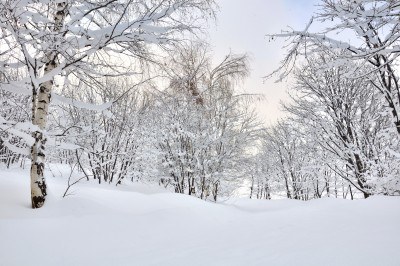
In recent years I have been able to adapt to many transformations, but the sudden change of seasons still surprises me.
Winter has arrived. Tonight, an icy wind blows. Last Saturday I was fishing bass at the estuary with my handmade harpoon, and the water was just a bit cold. Thirty-four bass, a heavy sack. Two for each of the boys of the school, and some for myself. Saturday night the whole village smelled of roasted fish.
Under the full moon, I stamp my feet in the snow. Neither my gloves nor my sentry’s greatcoat are warm enough. The sole of my right shoe is flapping again. It will be a problem to fix it. I do have some string, somewhere. We’ll see.
I have been walking along the outer wall, back and forth, since midnight. It must be past four. While I uncork my flask for another sip, I hear Klaus’ truck approaching, wheezing with the grave tone of a dying dinosaur.
Here it is. Still far away, but well lit by the moon. The driver stops, gets out, leans against the side of the truck. Stretches his arm inside the open window, signals with the headlights. Ta-ta, ta-ta. The usual double hit with the beam. I light a match as an answer. It is not Klaus; this man is leaner and shorter. I drop the match and instinctively put my hand in my pocket. I make sure to touch the old gun that I have never used.
He saw my little light. Gets back in the truck, approaches, but not too much. He knows that no foreigner can cross the outer circle, bounded by a line of cypress trees. I go toward him. When at twenty yards he stops, turns off the headlights. In the moonlight I can still see very clearly, distinguish colors. My hand, in my pocket, does not lose contact with the cold steel of the weapon.
He gets down from the truck. Beats his chest with his right hand, twice, in the quick motion that has now become the conventional greeting between strangers.
“I’m Antonio,” he says. “Klaus is sick.”
I wonder if I’ll never see Klaus again. The word sick can mean many things.
He goes towards the back of the truck making sign to follow him. Limping. He has no fear of me staying behind him.
He opens the tailgate, gets in with the help of a rope, beckons me to do the same. I’m inside. Smell of rancid fat of some animal, blood on the floor. He’s been hunting.
He opens a box, there are blankets. They give off a terrible stench, which goes to my head. I mouth no.
He opens another box. Two jars of salt. I nod. A grinding wheel for sharpening knives. I nod again. A box with candles and matches. I signal to pass me those as well.
“Is that all?”
At first he nods. Then he remembers something, walks in the dark in search of an invisible object. Stumbles, curses. Lights a paraffin lamp. Now that the light illuminates his face, I see that he can’t be more than sixteen.
“I almost forgot. Klaus gave me something. He told me that you in the city like these things.” Our wooden cabins are called the city.
A mouldy chest. He opens it. The swaying light of the lamp illuminates the soft lines of a reddish object.
“A bass,” he says.
I bow down, I stroke the wood of the instrument, in the uneven light of the lamp some wood veins sparkle.
“No, it’s a cello” I say. He grimaces, meaning whatever you want.
I pretend little interest. “Dried meat. You have any?” I ask, unable to look away from the chest. He shakes his head fast, he doesn’t. I see a hint of concern in his eyes. Did he bring the case for nothing?
“For that… For that I’ll give you six fish. Six bass for a bass”, I say, making to stand.
He’s doubtful. I open the bag to show him how big they are. He smells. They are fresh. Fished Saturday; held in the snow. He still seems uncertain. I pull out two bottles of firewater from the bag, I place them next to the fish. I hand him my flask as well. “This for you, for the journey.”
He nods. Quickly grabs the flask, holds it, satisfied. A wolfish grin blossoms on his face. He claps me on the shoulder twice, the deal is done. He wants to go home. Now, before daylight.
He helps me to offload the case. I open again the lid while the truck disappears behind the low hill. I’m crouched in the snow. I can not play, still I take the bow, try a string. A warm, magnificent timbre. I smile. I know what to do.
Six A.M., my shift is over. My old watch stopped months ago, I know what time it is by the light that spreads before dawn. I carry the box on my shoulder and I go toward the wall of the city. Now, breakfast and a two-hour lesson with the children.
I get to the warehouse. I take out the instrument, give it a good cleaning with a rag. The strings are all right. I have some oil, I gently pull out the pegs, clean them well, lubricate them, put them back, check the tension of the strings. Everything seems in order. Nothing broken. No rust on the metal of the strings. Tuning, I am not able to do.
I get in by the kitchen door, careful not to make any noise. Maria is making tea, with her back to me, doesn’t hear me. I pick a string, she turns towards me, I’ve never seen her like this, her mouth open, motionless. She hugs me: certainly she has not seen a cello since the end of the war.
I pour myself some tea, I sit down while she takes it, caresses it, tunes it. It takes just a moment.
While I bite my bread, leaning back my aching body, I see her sit down, hold the instrument between her knees. Closed eyes, curious, frenzied hands. Quick movements with sudden stops, in a squirrel-like motion. She remembers. She does remember everything.
I’m done. I wash the dish and put it away. The tea, I take with me. Sounds of laughter, the kids are coming. We look at each other: no maths today.
We go, we have the lesson to do.
Few in the old world were expecting a war, and certainly not such a quick one. The first few episodes – Sarajevo, Tbilisi, Lagos – we didn’t even connect them, and what followed happened in a flash.
A few weeks and we were isolated: no news, phone, Internet. I remember our lost expressions; we betrayed by all those things which before had become indispensable, and then died leaving us mutilated. Annihilating us.
I was in Milan with Giulia and the children, when it was attacked. Against the common wisdom circulating among the people, we took the car, loaded blankets, biscuits, water and tanks of fuel (I remember, I took the computer with me, how pointless). At night we found ourselves somewhere on the Adriatic. A port with big ships. We boarded, huge crowds under military escort. I slipped on the wet gangplank, fell into the water, hit my head. Someone must have rescued me. I remember the fever, a cabin with other sick men and a little boy in uniform opened the door and told us: “Going to Spain.” Instead, after two months, I ended up here. I woke up from the fever, got out of the cabin, I explored the ship without a living soul. Giulia, the children, no trace of them. Maybe they did not even embark on the ship. Were they still alive, I would know if they were. They are not. I dove into the water, swam to the shore, walked along the estuary. I arrived here in the village. I was half-naked and unarmed. They gave me something to eat.
There is no lack of foreigners with fabulous and contradictory news, rumors about the end of the epidemic, the reconstruction of large cities on the other side of the peninsula, but I think that the shadow of the end has arrived on Earth. How do I know? I do not know. It is hard to imagine what is only fifty miles from here. There are no longer any conduits of knowledge that can embrace the planet. Only the eyes of ignorant travelers, fearful, that for a loaf of bread could tell any story. They eat what they find, drink from infected puddles and try to hide, frightened, when they feel the slightest suspicion of human presence, squeezing into a sordid hole holding some homemade rudimentary weapon.
I think I ended up in one of the few pockets of survival of the planet, although I can not be sure. Me and the two hundred survivors of the city. Here are goats, rabbits, dates, olives, fruit. A forest with wild animals. The epidemics seem to have reached beyond the estuary, where we never venture. Why us, why here: that is work for historians, if there are still some. But history is over. Maybe it’s just me, with my mania for numbers and calculations, remembering that in the old calendar today is January 1 of the year 2028.
The kids are sitting and looking at each other with stifled giggles, the entrance of the cello amuses them. They do not know what it is. They have never seen even a picture of a musical instrument, excluding the rudimentary reed flute I built for them last summer; a scarcely successful experiment. Still a little sleepy, cheeks red from walking in the cold, they are beautiful. I begin the lesson. Maria sits, positions the instrument, studies the kids one by one. She has red cheeks, it’s not the cold.
“Put away your notebooks, today no Maths. Today, thanks to our usual luck, we will have the opportunity to meet an extraordinary man with a strange name: Johann, Sebastian, Bach. In a little while we’ll talk about it. Now, relax and listen. Listen carefully”.
Maria begins. The sound is warm and immediately envelops and transforms the room. No one seems to breathe. I must have bought a good instrument, worth all its six bass, the two bottles of brandy and all, and especially my precious flask. Maria plays with confidence and perfect expression the growth of increasingly complex notes. Cello or not cello, she never stopped practicing. I know by heart each passage of this piece too, with Maria we sang it so many times in the dark nights, humming it with our mouths closed. How much music there is in our memory, now that there are no more music machines. Many a night I woke up to the plaintive murmur of her voice and found her bathed in sweat, in the middle of some inaccessible nightmare, phrasing some unknown piece in her sleep with her supple fingers, using my arm as a fretboard, lingering with a vibrato on my wrist.
I hold the warm cup in my hands, I stand at the window savoring every note. A corner of the glass is broken, an orange rag fills it. I do not have any pieces of glass to replace it. I wonder if any of us could learn to make glass? What does it take? A furnace, sand… I do not know exactly. I raise my arm to greet Maurice and Nina, who pass by holding buckets of steaming goat’s milk. Beyond the large window, a diagonal line of flying ducks. A foggy, yellow morning light has dawned from the estuary.
I am happy. It always does that to me, after a night shift.
 Ideas for a tall story